Whats the Earliest a Baby Can Be Born and Survive
Why Are Human Babies So Helpless?
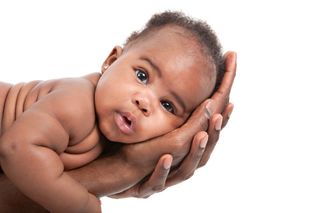
Some animals come into this globe more cocky-sufficient than others.
Many can fend for themselves without any parental supervision almost immediately — picture infant sea turtles hatching on the sand and and then somehow finding their way to the ocean.
Other animals, like newborn giraffe calves, are able to clamber upright and walk around on their ain within hours of birth. [In Photos: How Babies Larn]
Human babies, however, are a unlike story.
For the first ii months of life, they can't lift their heads without assist. They unremarkably curl over for the first time at virtually 4 months, and sit down upwards at around half-dozen months. They usually beginning standing at almost 9 months, and take their beginning tentative steps at around 1 year one-time, co-ordinate to baby developmental milestones compiled by the Centers for Disease Command and Prevention (CDC).
But even then, babies are just getting started. Fine-tuning the well-nigh bones survival skills, such equally walking and feeding themselves, takes at to the lowest degree another year or more than, and the piffling ones generally remain dependent on parents or caregivers for well over a decade earlier they're even able to begin to navigate parts of the earth on their own.
And that's OK, experts say. The extra time that humans need to acquire these abilities is part of the evolutionary trade-off for having highly developed brains capable of managing complex reasoning, advice and social interaction, alongside the concrete requirements and capabilities of our adult bodies.
Leaving the nest
When animals produce self-sufficient young, information technology's for a number of reasons related to both biology and beliefs, according to John Dumbacher, a curator of ornithology and mammalogy at the California Academy of Sciences. [The 10 Wildest Pregnancies in the Animal Kingdom]
Some animals need their immature to exist mobile as speedily every bit possible — in water or on land — because adults are constantly on the move and the young need to go on upward (or keep away from predators). Other species that don't roam every bit widely hunker down with helpless young in their nests or burrows.
And there tin be a lot of variation among animals from the aforementioned group.
Take birds, for example. "Songbirds — robins, bluebirds — those tend to be born more or less naked, with their eyes closed, and they tin't do much more than lifting upward their heads and getting a meal from their parents," Dumbacher told Live Science.
Newly hatched chickens, on the other hand, are much more capable of taking care of themselves. "They accept featherlike feathers; they tin walk around; they can peck at the ground," Dumbacher said. And ducks, he added, tin can hop into the water before long after hatching and swim afterwards their female parent.
The variety and the hatchling's ability tin be partly explained by the size of the developed bird, Dumbacher said, which translates into the maximum size of the egg it can lay. Bigger-bodied ducks, chickens and geese tin lay larger eggs that hold more nutrients, so an embryo can spend more time developing inside. Songbird eggs are already equally large as they tin exist relative to the parents' body size, so their young are born in a less-developed country and require more fourth dimension nether the parents' wings, Dumbacher added. [That'due south Incredible! 9 Erudite Baby Abilities]
Biology and behavior
In that location is similar variability in mammals, Dumbacher said. Although all mammal newborns are dependent on their mothers for nutrition, some are more physically capable as newborns than others.
Foals can stand upwardly and walk independently before long subsequently birth considering adult female horses are big enough, and tin gestate long enough, for their young to develop substantially before birth, making them more physically capable even as newborns, Dumbacher explained.
Withal, shrews — similar songbirds — are born about naked and with closed eyes, and must be kept warm by a nest and their mother'southward body oestrus.
"With its loftier metabolic rate and a small-scale body size, it's difficult for something like a shrew to bear a baby for a long period of time," Dumbacher said.
Physical and metabolic limitations as well apply to human gestation and birth, co-ordinate to a written report published in 2012. [Why Pregnancy Really Lasts 9 Months]
Information technology was already known that the brains — and skulls — of developing babies tin can't grow bigger than they practise in the womb (on average) considering they wouldn't fit through the mother's pelvis. The study found that a nine-month gestation period (once again, on average) is likely the longest that a woman could safely sustain the accelerated metabolic charge per unit required during pregnancy.
But self-sufficiency of mammal newborns is dependent on more than a species' size and metabolic charge per unit, Dumbacher added. "It's besides determined past the environmental of the species, and how much of their behavior can be coded in instinct versus how much has to be learned from their parents," he said.
In other words, the more information about beliefs that a juvenile has to absorb from adults of its own kind, the more than important the part of long-term parental care is in integrating a young newcomer into the patterns and practices of the group.
That starts to explain the long road that a man babe must travel from helpless newborn, to child, to developed, because how much they need to learn from their parents most advice and social beliefs.
Slow and steady
The lengthy development process that humans experience is "a luxury," said Marianella Casasola, an associate professor in the Department of Man Development at Cornell University. And it extends even subsequently in life than experts in one case idea.
"There'due south a lot of evolution that goes on in the prefrontal cortex [of the brain] fifty-fifty into early on adulthood," Casasola told Live Science.
Though it may seem like humans' early physical capabilities lag behind those of other animals as newborns, in the long run, humans' lengthy period of relative helplessness somewhen delivers a substantial cerebral payoff.
"Nosotros know that things evolve in a certain mode because there's an advantage to it," Casasola told Live Scientific discipline. "The longer maturation rate allows us to develop much more than complex thinking."
Follow Mindy Weisberger on Twitter and Google+ . Follow Live Science's Life's Little Mysteries @LLMysteries , Facebook & Google+ .

Mindy Weisberger is a Live Science senior writer covering a full general beat that includes climate alter, paleontology, weird fauna behavior, and space. Mindy holds an One thousand.F.A. in Motion-picture show from Columbia University; prior to Live Science she produced, wrote and directed media for the American Museum of Natural History in New York Urban center. Her videos about dinosaurs, astrophysics, biodiversity and evolution appear in museums and science centers worldwide, earning awards such as the Cine Golden Eagle and the Communicator Honor of Excellence. Her writing has also appeared in Scientific American, The Washington Post and How It Works Mag.
Source: https://www.livescience.com/54605-why-are-babies-helpless.html
0 Response to "Whats the Earliest a Baby Can Be Born and Survive"
Post a Comment